Bloon
Gate CrashersBloon is a senior Lividite representative of the Assembly of Sentient Species and the official who receives D’armic, Allison Ridgeway, and their companions when they bring the human case before the Assembly. His decisive significance lies in the tension he embodies: he is neither a simple advocate for humanity nor an unquestioning executor of the Assembly’s judgment. Instead, he represents a political system whose procedures can admit uncertainty and investigate new evidence, while its prior decisions and slow communications continue toward catastrophe.
Identity and Institutional Position
Bloon is identified by D’armic as the Assembly representative responsible for hearing the petition. When he emerges to meet the delegation, he is an elder Lividite dressed in the elaborate vestments associated with his office, with a physique humorously attributed to a sedentary administrative life. His ceremonial appearance places him within an old institutional order, but his conduct is more measured than the hostile posture of Ruckk, the representative who has already sought to censure D’armic’s human codefendants.
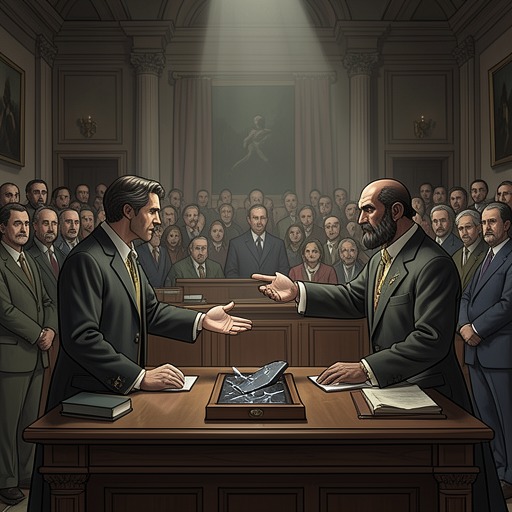
Bloon’s authority is procedural rather than absolute. He announces that the Assembly is ready to hear D’armic’s petition, but immediately warns that the Turemok representative has moved to censure the defendants. The vote stands at three for and three against. Because the measure is tied, it fails. When Allison Ridgeway questions why the Assembly uses an even number of representatives instead of guaranteeing a majority through an odd number, Bloon explains that a tie preserves inaction as a legitimate alternative: sometimes doing nothing is the most prudent action a government can take. This principle becomes a concise expression of his political temperament and of the Assembly’s capacity for restraint.
The Hearing and the Limits of Procedure
Bloon’s role changes when the hearing exposes a contradiction in the case against the humans. Ruckk presents the human expedition as a chain of crimes: piracy of Assembly property, violation of Assembly space, serial geocide, and the destruction of the Assembly vessel sent to contain the supposed threat. He also invokes the deaths of peace officers. Allison Ridgeway contests that account, but Ruckk treats the humans as already convicted criminals rather than petitioners whose evidence deserves examination.
Bloon interrupts that settled narrative with a specific technical question. D’armic has said that the Bucephalus could not have been responsible for the destruction under discussion, yet there were two ships involved. Allison supplies the crucial distinction: Magellan does not possess high-space technology. The revelation alters the evidentiary structure of the hearing, because it makes the human ships’ capabilities and movements central to determining responsibility rather than leaving the Assembly to accept a broad accusation of geocide.
Bloon then states that the Assembly is obliged to investigate the new evidence. This is not an exoneration, and he does not claim that the existing judgment has been overturned. His importance lies precisely in that narrower response. Against Ruckk’s demand for certainty and condemnation, Bloon preserves a space for verification. He recognizes that the case cannot be responsibly closed once the ship count and technological capacities complicate the official account.
Earth, Culpus-Alam, and Jurisdictional Conflict
The hearing also reveals that the dispute is partly a struggle over names and jurisdiction. When Bloon asks what the humans’ alleged Solonis B is, D’armic explains that the humans call Culpus-Alam by another name. Bloon replies that Culpus-Alam was an Assembly world and therefore fell under Assembly jurisdiction; humans had no authority in the matter. The exchange shows why the humans’ self-understanding as explorers cannot settle the conflict. Their actions are being interpreted within a larger legal order whose territorial claims they did not recognize.
Bloon nevertheless does not reduce the humans to their alleged crime. When Allison states that her petition is intended to stop retaliation against Earth and to present evidence that the humans were framed, Bloon asks what the petition actually is rather than dismissing it outright. His question gives the human delegation a formal opportunity to articulate its purpose at the precise moment when Ruckk insists there is nothing left to discuss.
That opening cannot immediately save Earth. Bloon explains that, even if the human evidence proves genuine, the punitive expedition against Earth has already been authorized and cannot be halted in time. The armada was dispatched weeks earlier, after the destruction of Kulla was reported. The distinction between unwillingness and inability is crucial: Bloon does not say the Assembly will refuse to stop the expedition, but that the order cannot reach it before the ships arrive. The Xecoron is expected to reach Earth shortly, while other ships are scheduled to reach the human colony worlds and enforce sequestration.
Judgment, Uncertainty, and Moral Responsibility
Bloon’s institutional caution does not make him politically neutral. He belongs to the body that has authorized the punitive expedition, and he has participated in a system that treated the humans as convicted world killers before their evidence was heard. Yet he also refuses to let procedural momentum become a substitute for truth. His statement that genuine evidence would require the Assembly to investigate, followed by his promise that humanity would be compensated for the Assembly’s misjudgment, marks an official willingness to acknowledge error rather than protect institutional infallibility at any cost.
Ruckk challenges even this limited openness, accusing Bloon of accepting the human account on faith. Bloon’s response is not a declaration of belief but a commitment to inquiry. That distinction places him between two forms of certainty: the humans’ insistence that they have been framed and Ruckk’s insistence that they are irredeemable criminals. Bloon’s procedural ethic recognizes that both the facts and the consequences matter, even when the consequences have already outrun the institution’s ability to correct them.
Narrative Function and Significance
Bloon functions as the hearing’s threshold guardian, but he is an unusual one: rather than blocking entry, he makes entry into the Assembly’s deliberative process possible. His questions allow the case to move from accusation toward examination, and his explanation of the tied vote presents institutional hesitation as a safeguard rather than mere weakness. At the same time, the delayed punitive expedition exposes the tragic limits of that safeguard. A government may permit inquiry, acknowledge uncertainty, and even intend compensation, yet still be unable to undo violence already set in motion.
His contrast with Ruckk gives the Assembly a divided voice rather than a single alien will. Ruckk speaks in the language of completed judgment, criminality, and punishment; Bloon speaks in the language of petitions, evidence, jurisdiction, investigation, and possible compensation. Through Bloon, the novel shows that cross-civilizational contact is decided not only by weapons or technology but also by who controls the categories through which an event is named. His measured conduct does not erase the Assembly’s failures, but it creates the narrow institutional opening through which those failures can become visible.